What makes a Heartwood Sauna? Insights from the team that crafts them
02/04/2025
In our workshop, on the outskirts of the historic market town of Machynlleth, in the foothills of the Eryri National Park, our team builds each sauna by hand with a passion and commitment to exceptional craftsmanship.
We spoke to some of our carpenters and designers to learn more about what goes into making a Heartwood Sauna, from the materials used to the knowledge and expertise each individual brings to the process.
Arta - Designer & Carpenter
Robin - Workshop Manager & Lead Carpenter
Frew - Workshop Supervisor
Tell us a little about what you did before you joined Heartwood and how it has shaped your role here.
Robin: Before joining Heartwood Saunas, I worked in various roles, and each has contributed to my knowledge and skill set, supporting what I do at Heartwood. Perhaps the most notable of those roles, which continues to inform my work here at Heartwood, was training as a tree surgeon, which meant I learnt about different tree varieties and their characteristics. From there, I went on to work in a sawmill, which means I have also seen first-hand the entire process wood goes through before it becomes a material we can use to craft saunas. I’ve been a sauna user and advocate for many years and, throughout several summers, managed the build of a travelling festival sauna at events across the country, so I came to Heartwood with a strong understanding of saunas and sauna bathing.
Frew: Outdoor work and roles that keep me connected to nature have always appealed to me. I worked on a dairy farm, then moved into more hands-on, creative jobs. I started out as a builder, then moved into carpentry, learning new skills along the way. Being self-employed for many years helped prepare me for the supervisor role I now have here at Heartwood as I learnt how to manage my time, manage projects and source the right materials for each job.
Arta: I trained as an architect and spent many years, post-qualification, working for an architect’s studio in London, where I gained experience across a range of projects and clients. I left London just before lockdown to travel around Europe to volunteer in eco-communities and learn about natural buildings. While travelling, I was drawing and sketching and exhibited some of my work at galleries across Europe before I eventually found myself in the rugged landscape of Mid-Wales. I’m originally from Latvia, where sauna bathing is just part of the culture, so when I saw an opportunity to work for Heartwood Saunas, where I could combine my knowledge of saunas with my architectural background, I knew it was the kind of opportunity I’d been searching for as I also wanted to learn more about building and carpentry. I now divide my time between office-based design work and the workshop. Each role informs the other, giving me a much deeper understanding of crafting a sauna.
What is the most enjoyable and satisfying part of your job?
Robin: As workshop manager, much of my time is spent overseeing the team and managing the workshop production schedule. When I first started, I was doing much more carpentry, but the team has grown a lot in the last few years, and these days, a big part of my job is to support the team, offer guidance, and ensure each project is progressing smoothly. I enjoy training the team, encouraging their development, and working with the wider management team to support the company's growth and ensure we’re as sustainable as possible across each aspect of the business. When I do get to work on the builds myself, I enjoy being in the flow of the work and just focusing on the task at hand with no distractions. I also still enjoy that last walkaround we do on a sauna to check it’s all perfect before it’s wrapped, loaded and delivered to its new home. At that moment, you see the sauna as a whole, not just as the sum of its material parts. Looking at what we’ve created as a team is always rewarding.
Frew: I love that feeling of flow when working with wood and the joy of crafting something beautiful with my hands. I’m also driven to produce the best work I can and especially enjoy that moment at the end of a project when we can look at the end result and all the work that’s gone into making a sauna and feel proud of the achievement.
Arta: Our founder, Olly, is committed to ensuring we produce the very best work in all that we do and has an incredibly optimistic attitude, which means we, as a team, approach everything with the belief that we can find a solution to any problem or issue that comes up. It’s beautiful to work as part of a team and feel like nothing is impossible when we put our heads together. This attitude resonates across the company and has also crossed over into my personal life, helping me develop a resilient and positive attitude to any challenge.
Why is the choice of material so important in sauna making?
Frew: The choice of material—in our case, wood and different types of wood—is really important as it influences the feel of the sauna. Material choice affects how smooth things are to the touch, how hot they become in the sauna, how visually elegant they are and how they express that dance between softness and strength.
Arta: As an architect, picking the right materials is essential to bringing the design to life. Selecting the right wood for the different parts of the build is as critical as ensuring correct spacing and ventilation within the sauna. Each element and material must be chosen carefully for a small space like a sauna, which has to withstand huge temperature variations. There is much less scope for flexibility in a smaller structure like a sauna than with a bigger building, which means each decision is critical to the space working effectively. Material decisions are also fundamental to ensuring we produce saunas in the most sustainable way possible to ensure longevity and minimise waste.
Robin: The material used needs to perform well in a sauna environment. It has to be functional, durable and able to tolerate both the sauna's heat, as well as changing external weather conditions and temperatures. As a company committed to making saunas that minimise our impact on the planet and the environment, we question each component's provenance and carbon footprint. That means, as far as possible, working with suppliers who align with our principles and who themselves are as sustainable and environmentally conscious as we are. When it comes to wood, the biggest resource used in sauna making, we never compromise on quality or provenance and always ensure that the wood we use comes from well-managed, sustainable forests in the UK. Where we spend our money can have such an impact, which is why, in our saunas, every element is the best version of itself - that’s what makes them so special.
What is it you love about working with wood?
Arta: Wood is beautiful and versatile. It’s an environmentally friendly resource that is used and will eventually decompose, returning to the ground. It’s also easy and fun to work with - and it smells good! You also don’t need that many tools to work with wood, so there is beauty in the simplicity of the work. Since coming to Heartwood, learning about wood has helped shape my design work, giving me a better understanding of the material and how it works in a build.
Frew: When you work with wood and start to understand its ways, you realise you can make it into any shape you want as it’s a beautifully malleable material. It feels ready to become something! I look at the grain and the structure of the wood, imagining how it might warp or change over time and where its place in a project might be.
Robin: I love the fact that wood is a natural resource that can grow abundantly and sustainably. When you work with it as a material and look more closely at each piece of timber, you start to observe the characteristics of each tree and how individual they all are. You also see all the things it could be and its potential. On a more practical level, I like looking at its structure and working out how any flaw, weak point or knot might impact the integrity of the sauna. If that means it’s not suited for the original function I had in mind, then I’ll start looking at where else it could be used - there are always so many possibilities.
Arta, as our in-house designer, can you tell us the three main design principles you consider when designing a sauna?
Arta: Firstly, everything has to be correct. It’s important to ensure you’ve thought about how it all comes together, how the materials interact, how water moves, and what will happen with the condensation. This is often down to the physics of the material and understanding how the material will respond to the sauna environment—what the heat will do, how the outdoor temperature will affect the material. This is a challenge in a small space like a sauna—the scale makes it harder.
Secondly, it’s essential to be meticulous about the sauna's layout and flow. Everything needs to work together—the distance to the stove, the door positioning, the seating height, etc. Having a well-planned floor plan for the sauna is non-negotiable.
Finally, as we’ve discussed, it’s about choosing the right material for the job.
What do you think makes a Heartwood Sauna so special?
Robin: The company is built on the values of Olly, the founder of the business, and those values still resonate through all that we do in the company every day. His goal was to elevate the outdoor sauna experience and create beautiful spaces that connect us, as humans, to each other and to the natural world. Olly’s no-compromise approach and unwavering commitment to making beautiful saunas means we always strive to create the most flawless saunas possible. You can trust that the quality is there all the way through a Heartwood Sauna - nothing is even a mm out of place, and in carpenter speak, each sauna is square to a tolerance that hardly anyone would expect to achieve. As a company, we’re committed to continuous progress and improvement in everything we do. Our designs and builds are always evolving, helping us stay at the forefront of outdoor sauna production here in the UK.
Arta: They’re beautiful! And they have been built to last a long time. Each sauna is made with dedication, and much care has been put into every step of the journey. They are saunas built for people, by people, in a positive, sustainable work environment.
What do you want customers to feel or experience when they take ownership of their Heartwood Sauna?
Arta: We want the client to have the most relaxing and enjoyable sauna experience possible. They should be able to relax fully, not see anything out of place, and have no visual or practical snags or imperfections that might draw the eye and disrupt the experience. For me, it’s also important that they have a sauna that’s easy to use and care for, which blends seamlessly into their lives and will continue to bring them joy for many years.
Robin: I want them to experience their sauna as a sanctuary, a quiet space to be enjoyed regularly. My hope for our clients is that stepping into their Heartwood sauna becomes the highlight of their day.
Electric or wood-fired: choosing the right heat source
Deciding whether to opt for a wood-fired or an electric stove is often one of the first things to consider when it comes to the design and usability of your sauna. While the final choice usually comes down to either a clear personal preference or is driven by obvious practical considerations, there are some key factors to consider that will likely influence the decision-making process. In this article, we’ve explored some of the key distinctions between wood-fired and electric saunas and asked some of the Heartwood Saunas team to share insights to help clarify the benefits of both options.
Start with the why
While delving into the differences between an electrically heated sauna and a wood-fired sauna is often an essential part of the research phase, you can also be guided in the right direction by first considering your sauna ‘why’. If the primary intention is to spend more time immersed in nature and to benefit from the sensory rewards of being outdoors and physically connecting to the elements through collecting and preparing kindling and logs, then a wood-fired sauna would likely be the right choice. Alternatively, if your intention is to maximise opportunities to use the sauna and reap the health benefits of sauna bathing on a regular or daily basis, then the convenience and speed of an electric sauna may be a better option.
Finding clarity on what is most important to you and understanding what is driving the purchase of a sauna early on in the decision-making process can usually make it easier to choose which heat source is most suitable. Knowing the ‘why’ can also guide the wider design consultation by ensuring choices are always rooted in the original intention for the sauna, which means it’s more likely to be enjoyed consistently over the long term.
“If our clients are ever in doubt as to which stove to choose, my advice is to go with the one that will help them to use the sauna on a regular basis”, Olly, founder.
Onnen sauna fitted with a 9kw HUUM electric stove
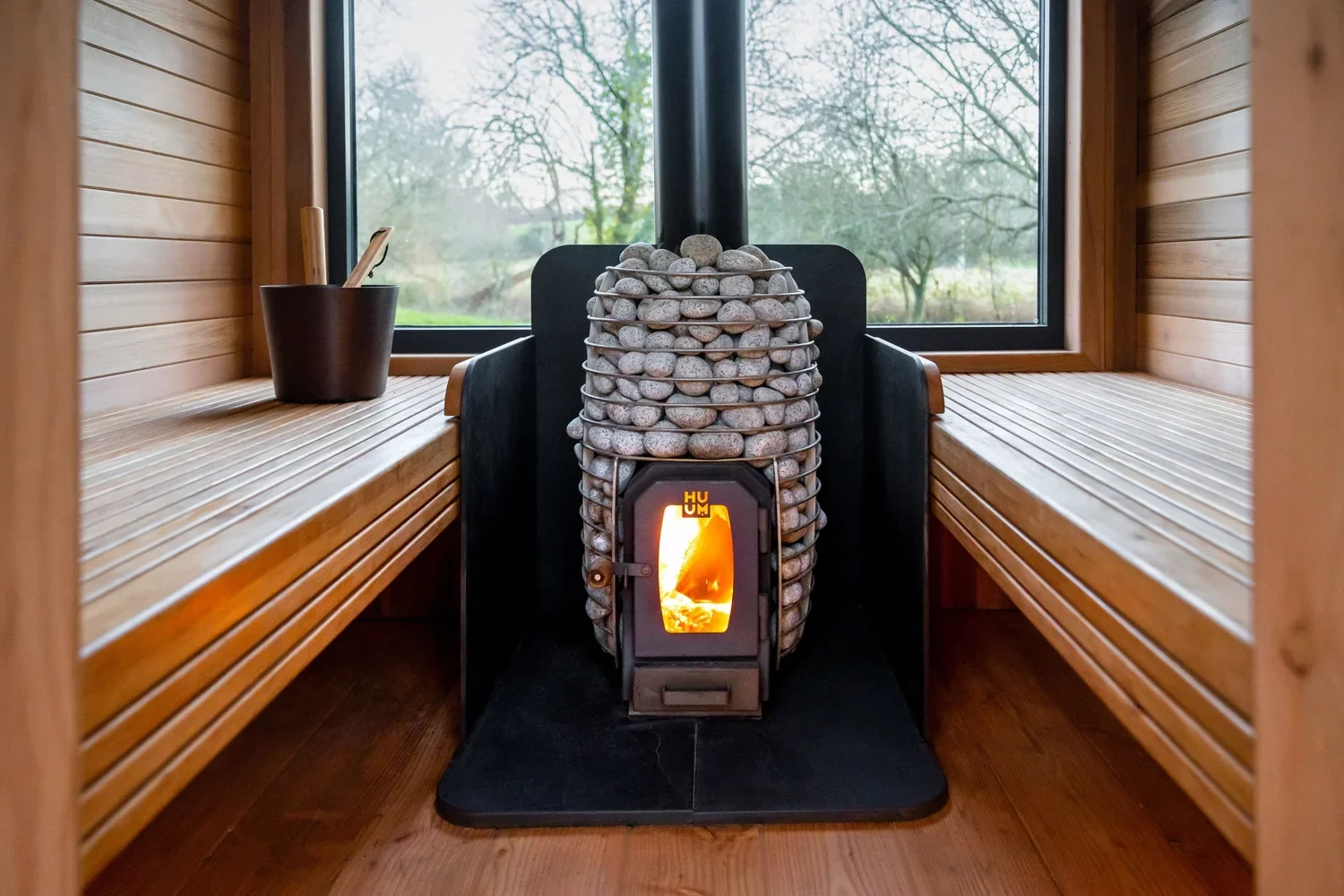
Aire + sauna fitted with a wood-fired 17kw HUUM stove, Scotland
Wood-Fired
A wood-fired stove is certainly the more traditional choice of heat source and has been central to sauna culture for centuries. Choosing a wood-fired stove connects you to this lineage, invites a slowing down and offers a more intimate connection with nature through the primitive ritual of sourcing wood then building and maintaining the fire. Requiring no power supply, wood-fired saunas are also 'off-grid' and, as such, offer greater flexibility for less accessible or rural locations, which can also create a more adventurous dimension to the sauna experience.
For those who choose a wood-fired option, the ceremony of preparing the fire and heating the sauna manually, tweaking and adjusting the heat to get it just right, adds to the more profound, meditative practice of sauna bathing. The tactile aspect of handling the organic texture of the wood and the resulting ambience conjured up by the smoke and the visuals of the flames helps the mind disconnect from the busyness and ‘always-on’ headspace we largely operate from in our daily lives.
While wood-fired saunas score highly on a more sensory level and offer a direct shot of nature, on a practical level, there are a few things to consider with wood-fired stoves.
Location is key. A remote sauna setting may predicate a wood-burning stove due to an absence of a power source, however, if the sauna is being situated in a private garden, it may be necessary to consider neighbouring properties or other practical factors which might prohibit the use of a wood-fired stove. If installing a sauna in an urban area, for example, DEFRA regulations in the UK relating to smoke control may need to be reviewed and considered. A first step to finding out what’s possible would be to look at the DEFRA Smoke Control Area Interactive Map (defra.gov.uk) to understand what the local rules are in your area.
While for some, the additional time and preparation implicit in the heating up of a wood-fired sauna is an integral part of the experience, it’s worth considering whether it’s possible to sustain this level of time investment and whether, in the long term, this might impact on the regularity with which the sauna is used.
“Wood-fired saunas require a bit more forward planning if you want to get the best from the experience. Gathering the firewood and building up the fire to get it to temperature takes time. A really large sauna such as the Arden will take approximately 90 minutes and the more compact Vapor will heat up in 75 minutes, so this needs to be factored in to the decision making process.” Robin, workshop manager.
When it comes to running costs of a wood-fired sauna, this will depend on where the wood is sourced. In order to ensure maximum efficiency and protect the long term health of the sauna and stove, be sure to source the best quality wood which is either well-seasoned or has been kiln-dried.
“The ceremony of preparing the fire and heating the sauna manually, tweaking and adjusting the heat to get it just right, adds to the deeper, meditative practice of sauna bathing.”
Wood-fired sauna in an Arden V
Electric
With digital heating controls that can be set remotely by an app, an electrically heated sauna can integrate more seamlessly into the fabric of contemporary life. The clear key advantage of an electric stove is the convenience and ease of heating up the space, supporting regular usage of the sauna.
“When guiding our clients on the decision to go electric or wood-fired, we’ll discuss how and when they intend to use the sauna. The HUUM electric stoves used in our saunas can be pre-set to be heated to temperature by a certain time, meaning your sauna can be ready to step into as soon as you arrive home from work. Ultimately, it’s about what feels right for each individual, but certainly from a convenience perspective, an electric sauna is less labour and time intensive.” Kam, Operations Manager.
In addition to the efficiency of an electric sauna, there are other advantages, including the fact that they are low-maintenance and easier to keep clean. There is also a subtle difference in the steam created by the electric stove, thanks to the greater stone capacity which yields a gentle, long-lasting steam.
When it comes to the location of your electric sauna, the main factor to consider is access to a power supply and how this would reach the sauna.
The cost of heating an electric sauna will be influenced by the current cost of electricity and your chosen provider, but as a guide, the unit costs for electricity multiplied by the kW output of the stove (for example 12kW in an Aire+) would give an idea of the cost per kW hour. An electric sauna can also be an environmentally responsible choice when paired with an energy supplier that sources power exclusively from renewables.
HUUM 15kw ‘Hive’ electric stove
HUUM 9kw ‘Drop’ electric stove
A personal choice
Remaining true to your original vision and intentions of how you’d like to use your sauna, will ultimately guide you to make the right decision. It can also be helpful to remember that whether you choose an electrically heated stove or a wood-fired stove, the wider health benefits of a sauna are the same and regardless of the heating element, the real joy comes from having access to a space dedicated to relaxation and well-being.
“It can be easy to get caught up in analysing the benefits of one heating source over the other. The team here is really familiar with helping clients navigate this choice and are always on hand to guide and advise on optimising your sauna design, whichever heating route you choose to go down." Olly, founder.
For more information on the HUUM stoves used as standard in our saunas you can visit HUUM sauna heaters and sauna controllers – HUUM.
You’ll also find the available heating options for each of our pre-designed saunas on their website pages.
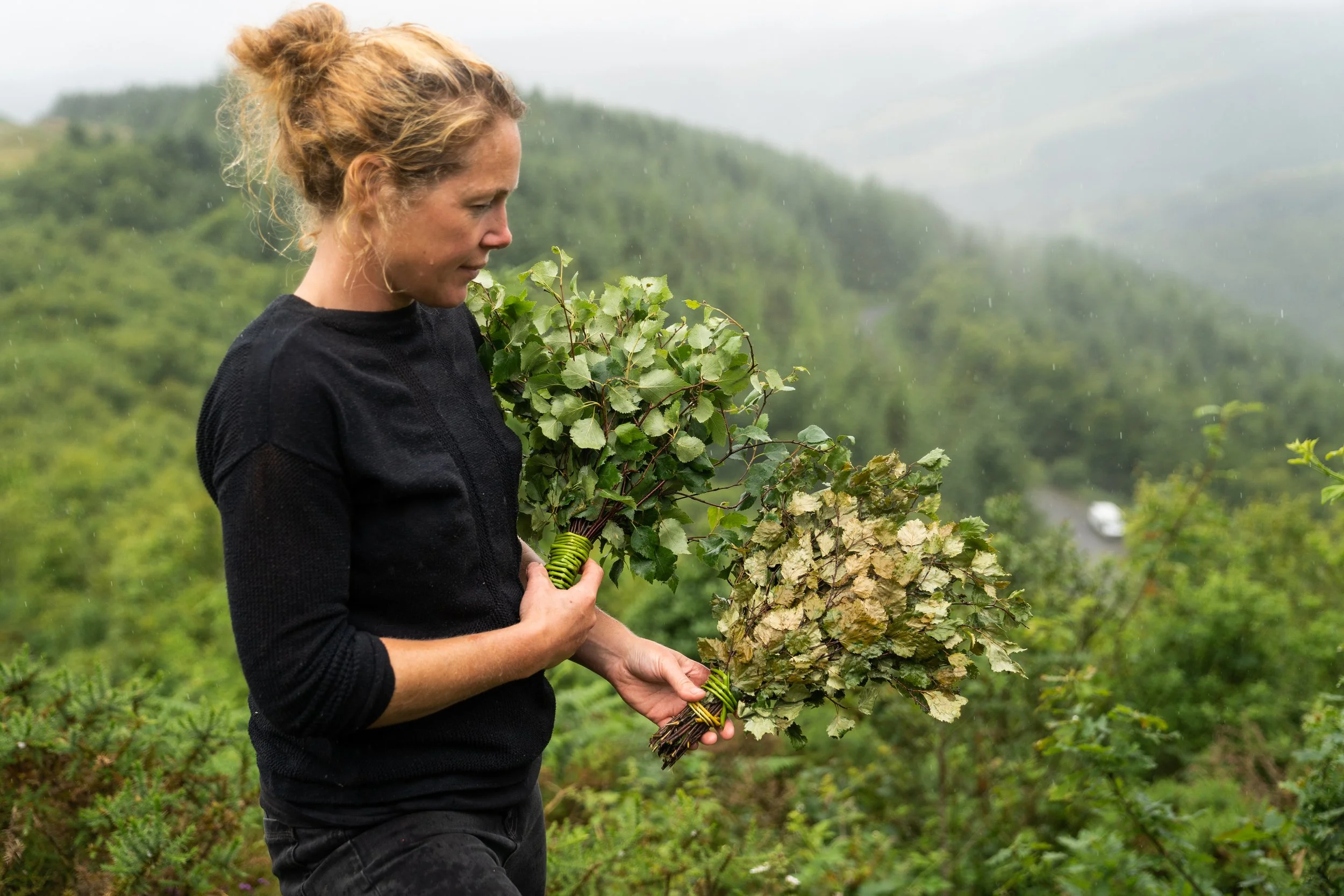
A Brush with Nature: Handcrafted Brushes for Sauna Sweeping
When we retreat to the sauna, we seek a feeling of serenity, presence and connection with nature. But beyond relaxing in the heat of a sauna session, it’s important to pay attention to how we engage with the space during it’s upkeep too, ensuring every interaction maintains its integrity as a place of tranquility and rejuvenation. This is what inspired us to collaborate with local maker Rosa Harradine to design hand brushes specifically for use in our saunas, and now available to purchase as part of our exclusive range of sauna accessories.
Beautifully handcrafted from natural materials, these hand brushes offer both efficacy and aesthetic appeal, enhancing the practical aspects of sauna upkeep and making sauna maintenance an enjoyable ritual.
Photography by Heather Birnie
Introducing Rosa Harradine
After graduating university in London with a music degree in 2015, Rosa Harradine sought to return to the countryside for a slower pace of life and connection to the natural world. This decision led her to the heart of the historic Welsh town of Carmarthen, where she discovered her passion for traditional craft.
“I originally started out with spoon carving, and I also did some basket making, and learned how to turn wooden bowls on a traditional pole lathe - but it was brush making that really stuck. I think craft is more beneficial than music to me in many ways, I find it more meditative. When I work with my hands I find I have time and space to be in the moment.”
Hidden behind an unassuming terrace, Rosa Harradine’s beautiful workshop feels like it exists outside of time. Previously occupied by a cabinet-maker, the workshop carries a rich history of craftsmanship and hand-making, now continuing its legacy with Rosa's artisanal creations.
“I came across this house for sale that had a really large workshop out the back. It had been on the market for a long time because no one wanted to do the renovation… Sometimes you just know when you walk into somewhere - it felt like it had the right energy for making. The renovation of the workshop was a lot - if I’m honest I was naive about the amount of work that would be involved, but I definitely learned a lot of new skills. We haven’t really started on the house yet! It’s funny what becomes important - my workshop is the nicest part of the property, but it’s also where I spend most of my time.”
Rosa started her business towards the end of 2021, and only a few months later, she was selected for Toast’s new makers program which really kick-started her brush making career. Her dedication to the craft and her unique approach quickly garnered attention, allowing her to establish a name within the artisanal community in Wales and beyond. Today, Rosa's brushes are known for their exceptional quality and beauty, combining traditional techniques with a contemporary sensibility. Her collaboration with Heartwood Saunas reflects a shared dedication to quality and a mutual appreciation for using beautifully crafted tools, transforming simple activities like cleaning into calm, grounding rituals.
“Using something that’s handmade changes everything about what you’re doing - it’s so much more enjoyable - and having natural materials in your hands is a much more tactile, pleasant experience.”
From Craft to Connection
Being a craftsperson, at its heart, is about more than just creating objects — it's about forging a bond between the maker, the material, and the user. Rosa Harradine’s approach to brush making exemplifies this philosophy.
“I think originally, I was inspired by practical things - things you can use every day and really enjoy, and I suppose I sort of had that feeling from my addiction to buying wooden spoons - I loved using them every day knowing the name of the person who’d made them - that real sense of connection with the craftsperson is so wonderful. I think the more you use something the more you can enjoy it and appreciate it, so I suppose I want people to get that experience from the things that i make.
But more recently I’ve been thinking about beauty as well - a number of people buy my work and don’t use it, instead they put it on a wall and admire it - and I used to not understand that as much but now I’m coming around to it - so I’m also inspired to make things that you could appreciate it in terms of its beauty as well as its functionality. I think people appreciate things in different ways, but certainly, I think using something that’s handmade changes everything about what you’re doing - it becomes so much more enjoyable, having natural materials in your hands, something so much more tactile, and miles more pleasant than interacting with a plastic brush and dustpan.”
This approach certainly resonates with Heartwood Saunas’ philosophy of integrating functionality with aesthetic value; as there’s a strong mutual focus on how thoughtful design features can enrich our experiences. Rosa Harradine’s work effortlessly balances practical use with a sense of beauty, adding a layer of depth and meaning to our interactions with would-be everyday objects.
“It’s always nice to work with other local businesses, and I love what Heartwood do. The saunas look beautiful, and I think my work fits in really well with Heartwood Saunas’ aesthetic. Functionality and beauty are clearly key to both of us. It was such a straightforward process working with Heartwood. I originally sent some samples of the different materialsto choose from, and I’m so glad the broomcorn was chosen because it’s my favourite and I think it’s the most effective material that I use. We decided together to use a dark colour cord for practical purposes!”
The Art of Brush-Making: Form and Function
Although certainly more striking than the average sweeping brush we come across in the UK, Rosa’s hand brooms resemble a traditional brush design seen across many brush making traditions across the globe, from Africa through Asia and the Americas.
“It’s not my design - that style of brush comes from lots of different places - Asia, Japan in particular, has a long history of brush making that’s kind of similar styles of brush to that, they’re also made in places in Africa. But I think I first came across the design online, when I found it I found it through North American brush and broom makers - it was a common shape of brush to make there - in North America, this style of brush is called a ‘Turkey Wing’ as it’s evocative of a Turkey’s wing. I just love how the fibre kind of splays out into that fan shape, there’s something about them that just feels really nice to hold in the hand and to use, they’re surprisingly light I think, and just really tactile.
I think the fanned-out shape at the bottom works really well because it’s very flat - it works more efficiently than a more rounded brush shape because it’s more agile. I use a brush just like this in my workshop pretty much every day, I just find it so effective at sweeping up all the mess that I make while I’m working!”
Besides the shape, the materials Rosa uses are also fundamental to the quality and performance of the brushes. For our bespoke brushes, Rosa uses broomcorn which is a type of Sorghum and traditionally a grain crop which is especially effective at picking up smaller pieces of dust and debris due to it’s wiggly, wispy ends where the seeds have been scraped away which are angled in different directions.
“I really like working with broomcorn because its the least processed material I work with, the most natural. I’ve got the long term goal of growing it myself - which would be amazing. I know there are some broom makers growing it in Northern France, which doesn’t feel too far away from here in terms of climate, and it’s also grown in parts of Eastern Europe. I think it’s definitely worth a try - it used to be grown in the UK in the 16 and 1700s, but I think over time because it’s something that has to be harvested by hand it stopped being commercially viable. The cost of labour (I assume) wouldn’t make sense, which is why it’s only growing in a few places in Eastern Europe and Mexico now.”
Rosa’s approach to brush-making combines traditional techniques with her own practical methods.
“It’s pretty low-tech I suppose, which is nice, you don’t necessarily need any specialist tools or equipment. So I wrap the hemp thread around a rolling pin (or you could use a wooden dowel but that’s just what I tend to use!) and that goes underneath my feet, so my feet control the tension of the thread, and then I take the fibre and separate it out into separate bundles. I start off by wrapping the hemp thread around one of those bundles then adding another one, wrapping round them both, adding another one, pulling the thread from the rolling pin underneath my feet, keeping the tension really tight all the time.
Brush-making is a wonderful process to learn, but the people who attend my workshops are always surprised by how physically demanding it is. Once I’ve added in all the bundles then I keep wrapping to create that the handle shape before adding in the hanging strap, then I carefully trim the ends to finish it off.”
If you’re interested in learning more about brush making, Rosa runs short courses in Camarthenshire and further afield, you can find out more here.
“Brush-making is a wonderful process to learn, but the people who attend my workshops are always surprised by how physically demanding it is.”
Mindful Sauna Maintenance
The decision to commission handmade brushes was driven by a desire to enhance the overall sauna experience - to transform cleaning into a meaningful and enjoyable part of enjoying using the sauna. Maintaining an inviting and clean sauna space is essential for maximising the benefits of each session. It’s not just about hygiene; it’s about preserving the tranquility and rejuvenation that the sauna offers.
Using Rosa’s handcrafted brushes, carefully designed and handmade from natural materials, adds a tactile pleasure to the cleaning process, so that sweeping down the benches with with one becomes an engaged, mindful practice. This approach to sauna maintenance ensures that every interaction with the space upholds its integrity as a place of relaxation and retreat. We recommend brushing down the sauna benches and floor before each use, as the sauna begins to warm up, before gently scrubbing with diluted sauna soap.
From Forge To Fire: The Story of our Handcrafted Axe
Summer 2024 marks the culmination of a very special collaboration, as we unveil our hand-forged, precision-crafted axes, now available as part of our exclusive range of sauna and outdoor living accessories. Partnering with the exceptional blacksmith and outdoorsman, Joe Garnett, this winter we embarked on a journey to design and bring into being these unique, durable and extremely versatile axes that not only embody our commitment to quality but also stand as a testament to Joe’s remarkable craftsmanship.
Photography by Heather Birnie
Introducing Joe Garnett
Surrounded by woodland and in the midst of a working farm on the Devon-Somerset border, contemporary blacksmith, bladesmith and leatherworker Joe Garnett hand-forges high quality tools for use in the home and for adventures in the great outdoors. With a background in bushcraft and survival skills, Joe has a passion for creating exceptional, functional tools that are at one with an outdoor lifestyle.
“My background is actually in bushcraft and wilderness living skills - and that’s all about self-sufficiency, the idea is that you can go into the woods or an area of wilderness with a few tools and be able to not just slow down the rate at which you’re dying, but actually thrive.”
But as well as an outdoorsman, Joe has always been a maker too. Starting with leatherwork in his teens, then woodwork, he eventually found his way to general blacksmithing and toolmaking, which he began to practice over ten years ago.
“I’ve always been a maker - I definitely got that from my parents, and in bushcraft, you’re making things all the time as well. From working with leather and wood, it felt like a natural progression to move into blacksmithing - going from softer to harder materials. And it’s still essentially the same in that you can add or take away material, but what’s magic about metal work is that you can move material as well - you can change it’s shape and form.”
The earlier part of Joe’s metalwork journey took him into restoration and conservation blacksmithing, working on National Trust properties and and old buildings around Oxfordshire, before he pursued his personal interest in tool making and began working alongside like-minded blacksmiths, forging high quality knives, axes and kitchenware. Then, last winter, following the accumulation of his experience, Joe converted an old stable into his new workshop and founded Thorn Wood Forge. The forge specialises in hand-crafted premium tools, created from high-quality materials. Each unique product is designed for both beauty and functionality.
“I think artistry has got to be a part of the vision. Without it, you just end up making things that have already been made. My background in bushcraft helps me understand the real purpose of each tool - it's about creating something that truly fits its intended use. Introducing an artistic element is really important, especially with the woodwork of the handles. They’re personal, and need to look and feel good too.”
“I think artistry has got to be a part of the vision. Without it, you just end up making things that have already been made.”
Form, Functionality and Philosophy
Joe takes his inspiration from the outdoors and his background in bushcraft and survival skills - which is why functionality is so important in his design and craft.
“Mainly I take inspiration from the outdoors - it’s my favourite place. There’s nothing that makes you want to make tools more than using them. The satisfaction of using something you have made is awesome.”
But as well as functionality, Joe has a passion for quality, which is clearly reflected both in his work and in the materials he chooses to work with. When it came to creating our axes, Joe worked closely with the Heartwood team to create a versatile axe that is comfortable, elegant and incredibly capable.
“It’s really great working with Heartwood Saunas because it’s a company with a similar ethos, especially in terms of focusing on quality and attention to detail. It’s not just about form, its about function as well, and combining the two; it seems that everything we do aligns really well in that way. Many blacksmiths may say ‘that’ll do’ or ‘good enough for a country job’ but our workshop motto is ‘do it properly’. If you’re going to do it, spend the time, do the research and make something that’s going to last.”
“Mainly I take inspiration from the outdoors - it’s my favourite place. There’s nothing that makes you want to make tools more than using them.”
The Making Process
Each Forest axe is individually handmade by Joe in at the Thorn Wood Forge workshop in Hinton St George. The initial forging process starts with punching a hole through a block of EN9 steel with a fly press to create the ‘eye’. Then, a drift is hammered through the eye and the ‘cheeks’ of the axe head are drawn down. Once the eye is stretched, the blade of the axe is spread out, sweeping out from the eye to the cutting edge. The profile of the axe head is then refined using a grinder to sharpen up the lines, before it’s taken back to the forge to undergo what Joe calls ‘breaking the corners’ - running a hammer along all the edges to create the chamfer (sloped edge), a detail which gives the axe it’s distinctive polished look.
The axe head is then meticulously inspected to ensure quality, and that it is level and even, before it is stamped, and undergoes a four-stage heat treatment protocol to refine the grain structure of the steel, then harden and temper it. The axe head is then burnished, sharpened and buffered.
The ash handle is cut and shaped with an octagonal cross-section for grip, and the ‘kerf’ (slot) is cut in the top of the handle before the head is fitted to it tightly. Then, a kiln-dried walnut wedge is driven into the kerf which spreads out the top of the handle to fill the eye and secure the axe head in place.
A brass riveted tube is inserted into the hole at the base of the handle and a short leather lanyard attached for securely hanging the axe when it’s not in use. Then, the leather sheath is hand-cut, assembled, sewn and burnished.
Versatile, Practical, Intelligent Design
Although splitting firewood for a traditional wood-fired sauna session was our first priority for the functionality of our axes, Joe worked to create a design that could fulfil the potential wider demands of an outdoor lifestyle, but feel light, comfortable and easy to use for just about anyone.
“The poll section is quite useful if you ever need to bang in a wooden wedge, or you’re taking it camping with you and you need to bang in tent pegs, but it’s narrowed off slightly on this axe, so it’s a bit lighter weight, easier to put in a daysack if that’s relevant for you, or perhaps just easier to wield, if you’re young, if you’re old, if you’re strong or you’re not so strong, having a lighter weight is really quite useful.
The narrowness makes it really fast and it will bite into a wood really well. If the blade is too wide it will just bounce of a piece of wet or dense wood, so you need a narrower blade to bite into it, then that speed carries the axe through to split it. The handle is made of ash which is the traditional wood to use for axe handles in the UK. Ash is a wonderful, wonderful wood. It’s an incredible species and it’s so good for so many things.
Anywhere you’d want to use an axe, this axe will work. That’s what’s really nice about this pattern. You could use this for felling, snedding, splitting or carving. You could take this axe deep into the wilderness, have it as your only tool, and it would work. It’s just awesome.”
We quite agree - the whole Heartwood team has enjoyed test-driving the Forest axe for our wood-fired sauna sessions, and it seems to suit everyone - we simply can’t fault it.
“You could take this axe deep into the wilderness, have it as your only tool, and it would work.”
Photography by Heather Birnie
SUPPORTING OUR WOodlands: Sustainable British Timber
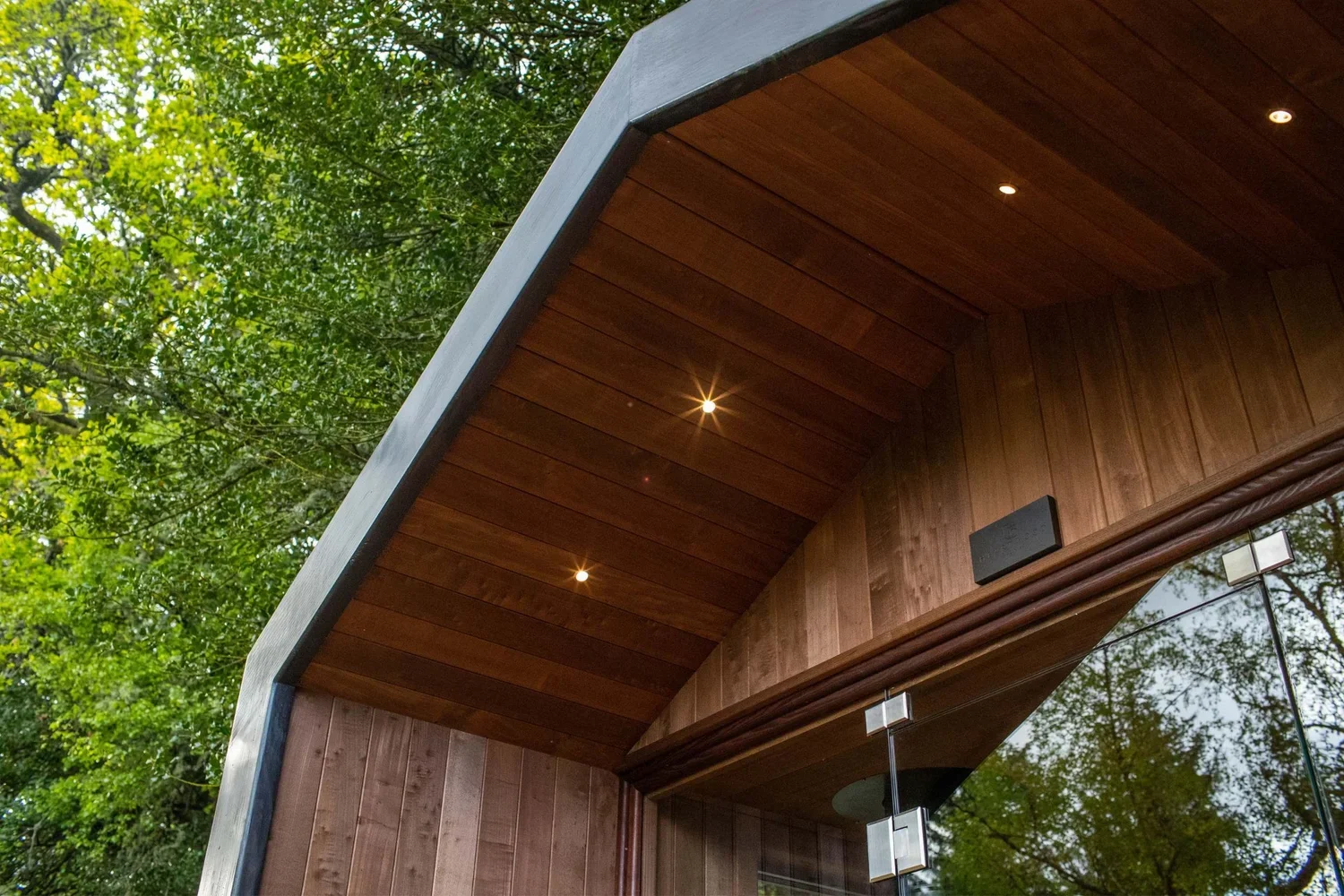
Although we use Welsh western red cedar for our external cladding, the premium knot-free cedar we previously used for our internal cladding and shingles came from mature forests in Canada that are hundreds, if not thousands of years old. This means that the trees' growth rings are closer together, producing exceptionally strong timber, ideal for withstanding the heat of a sauna. However, it also means that it takes hundreds of years to regrow these forests. Although they are certified as sustainable, as efforts are being made to regenerate the forest and preserve the invaluable wildlife habitat, the bottom line is that it is unavoidable that using these trees contributes to the destruction of rare ancient forests. This, as well as the carbon footprint of transporting the timber from Canada to the UK, has motivated us to seek more local, sustainable options that do not compromise on the durability and strength needed for quality sauna building.
Why the Switch?
Although we use Welsh western red cedar for our external cladding, the premium knot-free cedar we previously used for our internal cladding and shingles came from mature forests in Canada that are hundreds, if not thousands of years old. This means that the trees' growth rings are closer together, producing exceptionally strong timber, ideal for withstanding the heat of a sauna. However, it also means that it takes hundreds of years to regrow these forests, and although they are certified as sustainable, as efforts are being made to regenerate the forest and preserve the invaluable wildlife habitat, the bottom line is that it is unavoidable that using these trees contributes to the destruction of rare ancient forests. This, as well as the carbon footprint of transporting the timber from Canada to the UK, has motivated us to seek more local, sustainable options that do not compromise on the durability and strength needed for quality sauna building.
“If we can take timber that’s grows in 40 to 60 years, then give it the qualities of slow grown timber, ie. durability,
density, stability; it starts to make a lot of sense.”
Thermally Modified Timber
Native British heat-treated woods are local fast-growing hardwoods transformed by thermal modification, a chemical-free process that reconfigures the cell structure of the wood by superheating it to 210°C. This natural method removes moisture, resin and other extractives, resulting in an extremely stable and durable rot-resistant material, ideal for standing up to the heat, water and steam of a sauna and certified to withstand the elements for 30 years. Thermally modified woods were first developed specifically for use in saunas in Northern Europe and are widely regarded as one of the best timbers for use in sauna building. Using local thermally modified wood reduces our dependence on old growth timber and its associated negative ecological impacts, and increases the demand for UK timber, supporting the regeneration of our local forests.
“There’s great examples around here of woodlands that are functioning well. So they’re producing timber, but they’re also hives of biodiversity, and beautitul places.”
Norwegian Wood: The Tale of a Sylvan Sauna
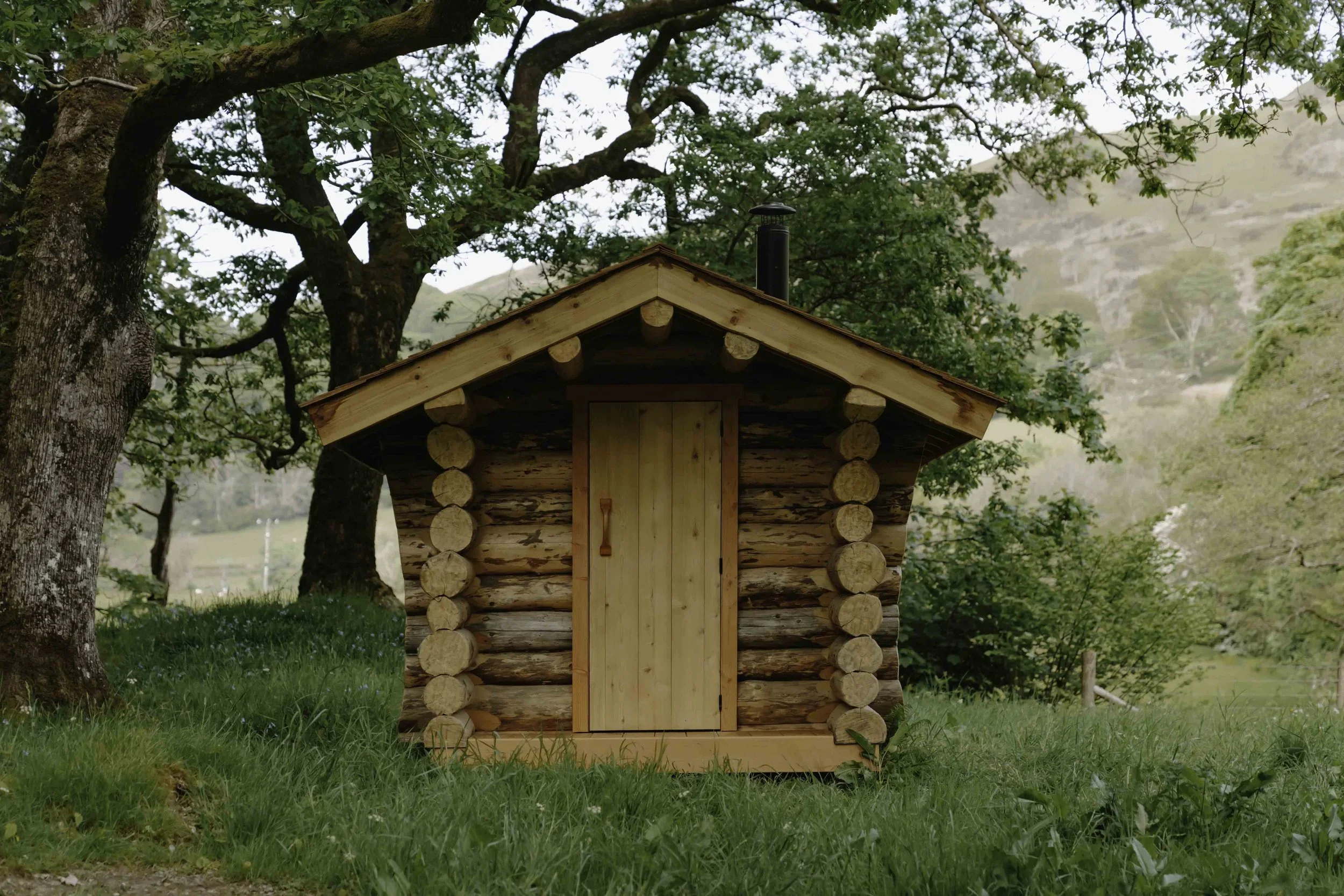
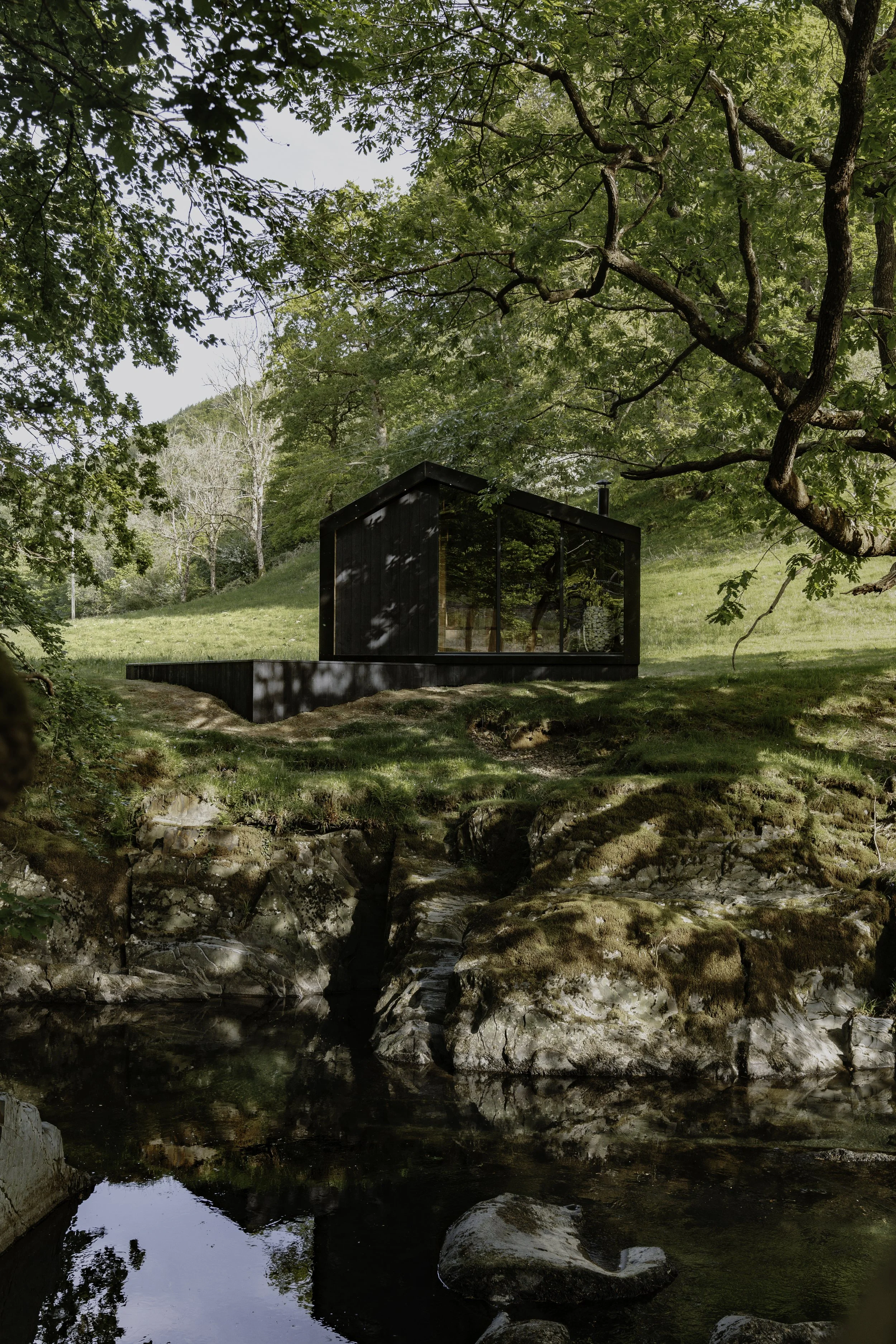
Every year, Rich Anderson of Norwegian Wood sails between the fjords of Norway and the shores of Wales to share traditional building skills with local communities. This summer, we joined forces with Rich to create a unique sylvan sauna - A traditional ‘grindbygg’ log cabin; handcrafted by Rich and fully fitted by our expert sauna builders. We caught up with Rich to learn more about his nomadic lifestyle, and how natural building, teaching, sauna bathing and outdoor adventure come together to create a timeless philosophy for holistic health… And yes, the sauna is for sale.
The Magic of Sailing, Sustainable Building and a Seasonally Nomadic Life
Norwegian Wood is a sustainable building and education company with an ethos based on the principles of sustainability, accessibility and physical and mental health. Rich set up the company in 2022, with a mission to bridge vernacular building cultures between Norway and the UK and share practical skills and practices that enhance wellbeing. In doing this, Rich has forged a semi-nomadic lifestyle that also accommodates his passion for sailing - twice a year, he charts a course between Wales and Norway, teaching and learning in both countries.
This seasonal rhythm offers a variety of experience and opportunity, and it embodies a commitment to cross-cultural connection and sustainable living. But on a personal level, Rich’s bi-annual maritime adventure also provides much needed time to reflect and reconnect with the elements.
“I really connect with that deep magic of sailing, of being shunted along across the waves by the elements, nothing else pushing you forward… And there are those incredible moments when you anchor-up in an isolated cove in the north-west of Scotland, you step off the boat and you’re in the middle of wilderness - and you realise how lucky and privileged you are to be able to experience that.”
Bringing Natural Building to Sauna Culture
Rich’s occupation, natural building, emphasises the use of locally available, sustainable materials and techniques that work in harmony with the environment, with an aim to create structures that contribute to a healthier, more sustainable way of living. Traditional Grindbygg roundwood timber framing is a centuries-old craft that engages the body as well as the mind. It’s a rewarding physical, outdoor activity that requires teamwork, focus and resilience. As Rich explains, in many ways, this merges seamlessly with sauna culture, as part of a holistic approach to a happy, healthy lifestyle.
“Bringing log building to sauna culture makes a lot of sense to me. It’s part of a kind of holistic approach to living, where health is just part and parcel of what you do - it’s not something you go and check with a doctor every now and then. Instead you are surrounding yourself with people, materials and practices that all build and maintain health. So natural building is part of that system, it’s part of that way of life.”
A traditional sauna enthusiast himself, Rich has spent time in Northern Europe where saunas are an essential part of the culture.
“The Finish, they won’t ask you how was your sauna, they’ll ask you how was your Loyly. Loyly (as Heartwood would know) is the steam. But the word doesn’t just mean steam, it also means spirit. And the spirit of the sauna is what makes it - so a good sauna to me isn’t about temperature, as much as the right mix of temperature and steam. That sound when the water hits the rock, that’s the ultimate ‘ah’; that’s the out breath.”
“Bringing log building to sauna culture makes a lot of sense to me. It’s part of a kind of holistic approach to living - you are surrounding yourself with people, materials and practices that all build and maintain health.”
British Wool: From Sheep to Sauna
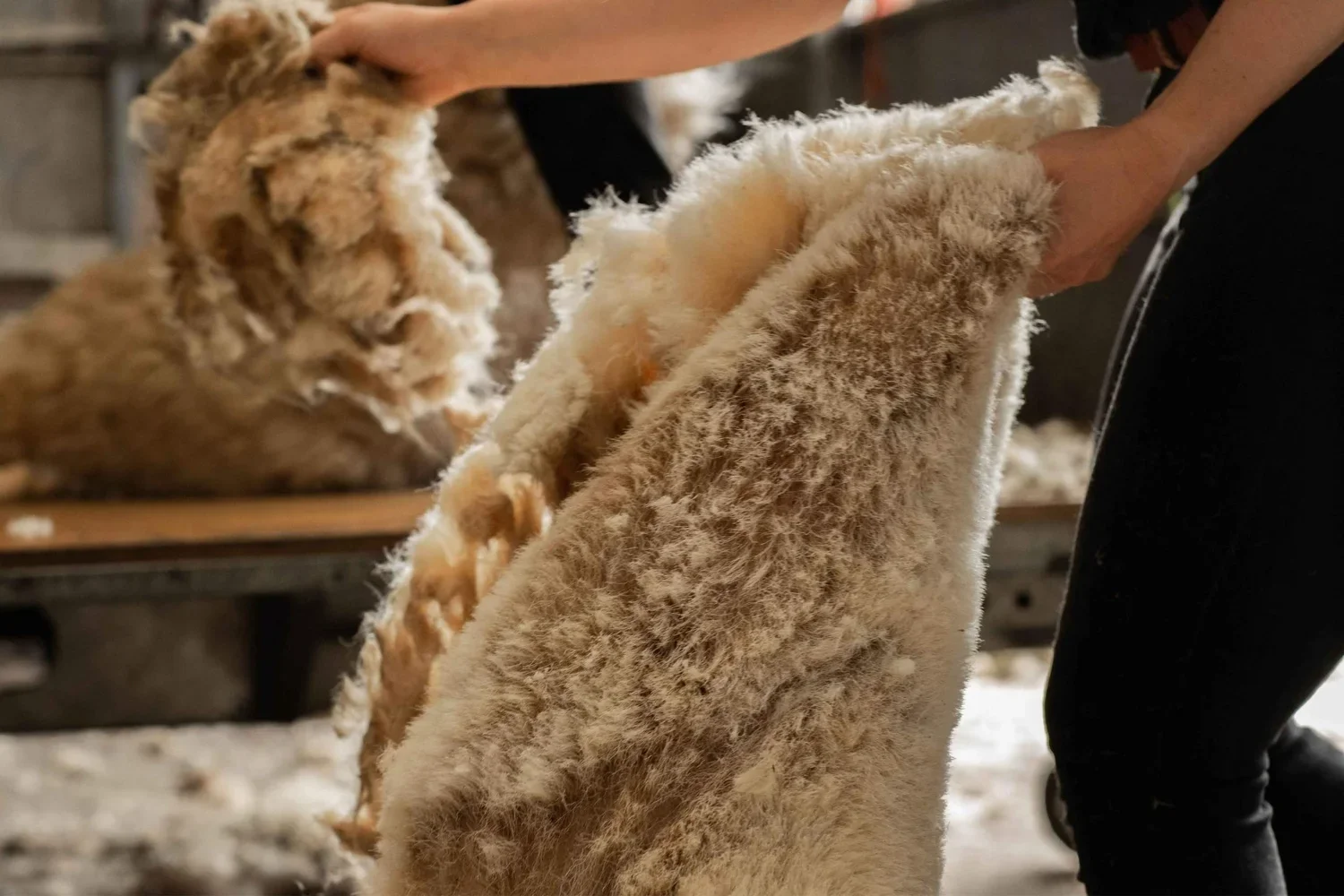
The Dyfi valley, where the Heartwood Saunas workshop is situated, consists of a rugged landscape of woodland, mountains, heathland, peatland and mixed farmland, the latter home to numerous sheep. We like to source our materials as locally as possible, and here in Mid-Wales, sheep farming is an integral part of the landscape and culture. Keen to know more about the materials we use to build our saunas and learn about the benefits of sheep’s wool insulation, we followed the process from sheep to sauna.
The Benefits of Wool - the key points…
Exceptional Efficiency: It has far superior insulating properties because of its higher density. Thermal conductivity is the ability for heat to pass from one side of a material through to the other. It is measured in W/mK, where a lower value signifies a better insulator. Sheep wool insulation has a thermal conductivity of between 0.035 – 0.04 W/mK, whereas typical mineral wool has a thermal conductivity of 0.044 W/mK. It also has excellent acoustic insulation properties.
Environmental Benefits: Sheep’s wool is proven to absorb and neutralise harmful substances – the wool is a natural protein made up of a number of different amino acid chains, of which 60% have a reactive side chain. These reactive areas allow the wool to absorb harmful and odorous substances including Nitrogen Dioxide, Sulphur Dioxide and Formaldehydes and neutralise them through a process known as Chemisorption. So using the sheep wool as insulation actually has environmental health benefits for the sauna.
Humidity Regulation: It regulates humidity. It can absorb and release up to 33% of moisture without compromising its insulation ability. The core of the sheep wool fibre is hygroscopic, meaning that it will absorb water vapour – making it perfect in an environment like the sauna where steam is produced.
Flame Resistance: Sheep’s wool has a naturally high nitrogen content making it one of the only fibers that is flame resistant and self-extinguishing. As a result of the wool’s high nitrogen content, if it were to catch alight, it would simply smoulder and singe away instead of bursting into flames.
Workability: Sheep’s wool is really nice to work with. No protective clothing or equipment is required to handle or install it - it does not irritate the skin or lungs when handled, unlike rockwool or glasswool.
Sustainability: As well as having superior insulating qualities which mean our saunas are efficient, sheeps wool is a more energy-efficient choice in terms of manufacturing too. Since sheep naturally produce wool, it requires just 15% of the energy used to manufacture synthetic equivalents - the energy used is simply from washing the wool. It’s also 100% recyclable and biodegradable.
By using British sheep’s wool insulation, we support local farming communities, and we can be sure of the quality of the wool we use to insulate our saunas.
A Guide to Choosing an Outdoor Sauna
If you’re looking to buy an outdoor sauna in the UK, it’s likely you’ll come across off-the-shelf kits from overseas manufacturers. Generally speaking, these come in two basic designs - a cabin-style with a pitched roof, and a barrel-shaped sauna. While barrel saunas in particular have a certain rustic charm, and easy-to-assemble kits are appealing, there are some important points to consider when choosing the right kind of structure for the environment.
The Importance of Heat Efficiency
One of the key features of a good sauna is heat efficiency. Heat efficiency saves time and energy, and has a huge impact on the associated costs of running a sauna. It also affects the sauna bathing experience - particularly in a wood-fired sauna - the more efficient, the less time is spent tending the fire to maintain the desired temperature and the more time spent relaxing. Keeping an inefficient sauna consistently hot enough to reap the physiological and psychological benefits can be very challenging (and sometimes constant work!), and as such the task can significantly detract from the experience.
Insulation is paramount to good heat efficiency, and this is something that unfortunately, single-walled kit saunas (including barrel saunas) lack. It’s notable that such saunas can still work relatively well in climates that experience more snowfall as the snow itself acts as insulation, but these designs do fall short in temperate regions, such as the UK and much of Europe.
Designed and handbuilt in the UK, our saunas are thoughtfully engineered to work efficiently in a variety of climates, including temperate, temperate-maritime, oceanic, and continental (cold). Each of our saunas has layered walls and ceiling to ensure maximum energy efficiency. From outside to inside there is: the external cladding (and/or metal sheeting), a breathable waterproof membrane, 100mm British sheep’s wool insulation, a unique vapour barrier, a ventilation layer and finally, the internal cladding. This means that the internal heat is much less affected by external conditions, and the sauna can reliably maintain high temperatures throughout all seasons.
Longevity and Climate
Another major aspect to consider with outdoor sauna design is the structure’s ability to withstand the weather conditions of its intended location. In temperate climates, and particularly in the UK, there is high rainfall and humidity, which can cause structures to deteriorate faster than in colder, drier environments.
Barrel saunas are built with a single wall made up of lengths of board with overlapping oval joints; this unfortunately means that leaks can occur between the boards when it rains, or when fallen snow begins to melt. In the winter months, a barrel sauna must be covered when not in use, or be situated beneath a second roof, to prevent the need for continuous maintenance.
Metal sheeting or shingle roofs are leak-proof and are much more resilient. While the timber of shingle roofs isn’t inherently waterproof, the angle of the pitch can make sure that water drains from the roof effectively. A waterproof membrane beneath the external materials ensures water is prevented from entering the sauna even in very stormy weather.
It’s also worth noting, not all shingles are made equal - while spruce and pine shingles may be appropriate for dry climates, in more humid environments, such as the UK, cedar is a far superior choice. Cedar is widely regarded as one of the most durable timbers for outdoor structures due to its high resin content. Known for its natural resilience against moisture, decay and insect damage, cedar will not bow or sag in response to high rainfall, and will last a lot longer.
For the internal walls and benches of a sauna, it’s important to use knot-free timber, such as the thermally modified poplar and ash we use. This is because knots cause weaknesses in the wood which can become problematic in an environment where temperatures and humidity rise and fall causing the timber to expand and contract. Bear in mind, temperature differences are exaggerated dramatically in barrel saunas that lack insulation, so if you are considering a barrel sauna, it’s a good idea to check with the manufacturer that the wood used is knot-free.
But longevity is determined by more than just the timber used. In addition to selecting appropriate timber species for each part of the sauna, the rigid galvanised steel base and stainless steel fixings we use in our saunas will withstand corrosion (such as from salty winds in coastal locations), so no part of the structure should show signs of wear for very many years.
How Design Shapes the Sauna Experience
The sauna’s design and materials are integral to the sauna bathing experience. In a barrel sauna, the enclosed, curved walls to some, feel protective and comforting, but to others, can feel claustrophobic and stifling, really, this comes down to individual preference. However, it’s certainly true that a greater range of positions and motion is possible in a pitched or flat roofed sauna, with straight walls allowing for multiple bench tiers, offering a greater temperature range and ample headroom too. In barrel saunas, there’s only room for one bench tier, and headroom is seriously limited!
Barrel saunas usually include two benches, facing each other, making them ideal for social sauna sessions. Although it is possible to install windows at the smaller, circular ends of the sauna, for the most part, you would be facing a fellow sauna bather or the curved timbers of the space. Overall, the experience is more intimate, social and -for want of a better word- cocoon-like.
In a straight-sided sauna, there’s a lot more flexibility in design, so how intimate or open it can feel is very variable. Inward facing benches can promote social connection (as in the Vapor), whereas tiered directional benches (as seen in the Aire+) offer privacy and different temperature options, again, which is best is down to personal preference. Larger glazing elements are possible, which can offer a view into surroundings, adding another dimension to the experience - one of connection with the natural world. A view into nature can enhance the psychological and physiological benefits of sauna bathing, and, in our experience, the sense of expansiveness created balances the intensity of the heat.
Crafting Quality Saunas From Scratch - Why We Don’t Make Kits
Our saunas are usually built as whole structures in our workshop, and transported fully-built to site. If this isn’t possible, we build the sauna in-situ. Building in this way means that the saunas are constructed layer by layer, so both the breathable waterproof membrane, and the vapour barrier wraps around every corner, so we can avoid any gaps where walls are joined.
With kit saunas, even if the external walls are insulated and protected by a breathable membrane, weaknesses can occur where the walls are joined together which can potentially pose a significant threat to the sauna’s longevity and weather resistance.
Aside from this, it does affect the finish, particularly internally. Building a sauna layer by layer, we are able to create striking design features such as fanned corner bench seats, and we can match up internal cladding from wall to wall seamlessly, creating a natural, flowing feel to the space. Furthermore, the way our benches are designed and built offers maximum strength and stability that simply couldn’t be achieved in a kit format. If we were to attempt to create a kit version of one of our saunas, many of the key design features which make our saunas unique would be lost.
Handcrafted to Last: The Making of our Log Carriers
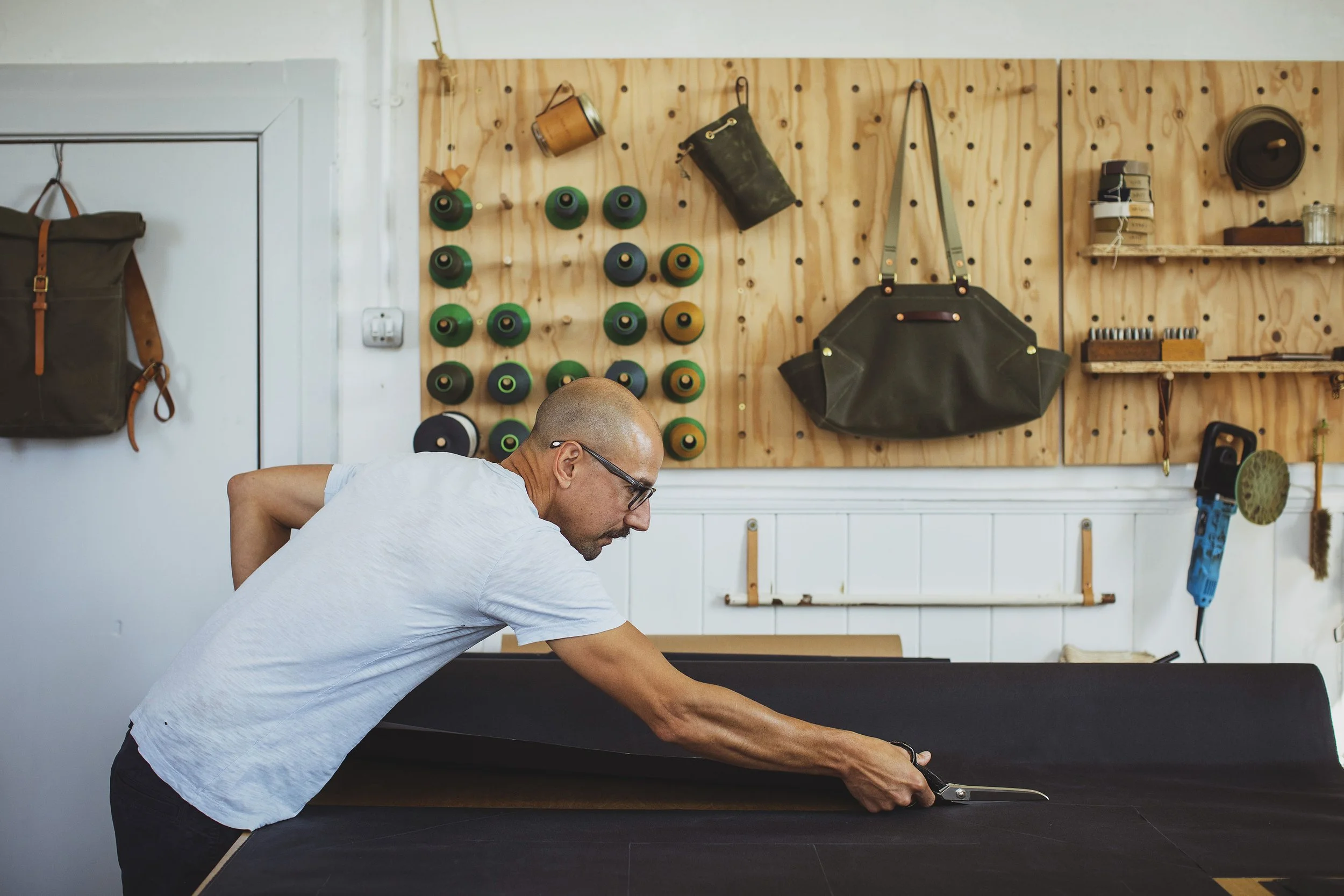
This autumn we had the privilege of working with talented local maker Mike Watt to design a unique hard-wearing log carrier for our exclusive range of handmade Heartwood Saunas accessories. Our versatile, durable log carriers are individually handcrafted by Mike at his workshop in the dining hall of an old primary school, just west of the Brecon Beacons National Park.
Introducing Local Maker, Mike Watt
Local designer and maker Mike Watt has lived in Wales since he came here to study in 1999, met his partner and fellow maker, Nia, and fell in love with the Welsh countryside.
“I came to university in Cardiff in 1999 and I've never left Wales. I met Nia at Cardiff - we lived on the same floor of accommodation in our first year - and we've been together since. Nia grew up in Llansadwrn, went to school in the primary school we now own, and having visited her and her family during our university summer holidays, I fell in love with the place. I just loved the hills, the rural nature and the friendly people.”
Although his background is in architecture, Mike began working with canvas about ten years ago, as he explains,
“I’ve always been a maker - there’s something in me that likes having my hands busy, it’s part of who I am.”
Mike was inspired to make a timeless, hard-wearing, high-quality bag for himself made from local, sustainable materials, that he simply couldn’t find readily available to buy. He then started working with leather, too, and he and Nia launched their small bag-making business, Rural Kind, in 2014.
Being relatively local and with shared passions, Mike was already aware of Heartwood Saunas when we approached him earlier this year to ask him about making a log carrier.
“I knew we had a similar ethos, and I am always looking to work with people with similar values - people who are making things really well with attention to detail and using local, sustainable resources.”
“I’ve always been a maker - there’s something in me that likes having my hands busy, it’s part of who I am.”
Robust, Natural, Sustainable Materials
Mike takes his inspiration from the Welsh landscape where he spends his time walking and mountain biking when he’s not making.
“I’m inspired by the hills, valleys and woods I’m immersed in on a day-to-day basis. Here everything’s a bit more rugged, and I think that comes out in the design of the bags I make. They’re natural, hard-wearing, and made to withstand the Welsh weather.”
Keen to protect as well as enjoy the natural world, Mike sources his materials in the UK from the most ethical suppliers he can find without compromising on quality.
“I want to be careful about where I source things, and how they’re produced. The canvas is made in Scotland; it’s really strong and durable, and because it’s waxed you can reproof it, which does a massive amount to improve the longevity of a bag. The high quality leather I use is from Devon, and it’s about as sustainably made leather as you can get - the cows are local to the south west of England, so the hides haven’t travelled a long way. They are a byproduct of the meat industry that would otherwise go to waste.”
The leather for the log carrier’s handles and motif detail is tanned with oak bark using an ancient technique that has been refined and perfected over centuries, at the UK’s only remaining traditional oak bark tannery - the site of which has been a tannery since the Roman times! Unlike modern tanning methods, oak bark tanning is a gentle process using exclusively natural materials which protects the natural fibres of hides, producing much stronger, more luxurious leather with unique colour tones and very little waste. The bark comes from coppiced oak grown in Cumbria for carpentry and charcoal, the hides are from local free-range low-environmental-impact farms, and the tannery are working towards being completely carbon neutral.
“I wanted to make something super functional and hard wearing out of good, sustainable materials that would last a long time. It’s got to be the way forward - making things to last.”
The Making Process
Each log carrier is individually handmade by Mike in his workshop, the ex-dining hall of a 162-year-old primary school. Starting with the wax canvas on the roll, Mike scratches the shape of the panel he needs to cut out with just a ruler and a bamboo marking device. Once the panel is cut, all the edges are pressed down with hand-rollers for the double folded seam.
“It’s quite hard work - I get through a few rollers! I do all the sewing on an old walking foot industrial machine - I sew a double line of stitching around the edge for a bit of extra strength and reinforcement, then I sew an extra base panel for the bottom of the bag to make it as hard wearing as possible.”
Once the log carrier has taken shape, the pocket is sewn separately before being secured, and the solid brass snaps are attached.
For the handles, Mike cuts a strip of leather from the strongest part of the hide and burnishes the ends to seal the exposed fibres and ensure a durable, weatherproof edge. He then buffs the leather to polish-off any residue, and uses a bit of beeswax which helps prevent degradation and gives the handles a soft-to-the-touch finish, before riveting them to the bag on his anvil using a hammer.
Elegant, Functional, Versatile Design
The finished design was a collaboration between Mike and Heartwood Saunas, but the overall vision for a functional, simple yet elegant log carrier was shared right from the start.
“I really like seeing a good material used well, and I think my focus on clean lines and simple shapes comes from my architecture background.”
From choosing the leather and the colour of the wax canvas, right down to the magnet-closure pocket and solid brass snaps and rivets, it was important to keep in touch and share thoughts and ideas in the design process.
“I enjoy a collaborative process, it’s great to get someone else’s thoughts about what a design could become. I was resistant to using brass rivets to start with because I’m so used to copper, and brass is a harder material, but I think they really work nicely with the canvas colour and I will probably use brass more for future projects.”
The log carrier can be used with the ends laid flat for longer lengths of wood, or the ends can be fastened up with the brass snaps to contain shorter logs. It also features a front pocket with a magnet closure for storing matches and firelighters. Although intended for carrying logs to the sauna stove or fire, the simple robust design is versatile and is also ideal for transporting camping supplies, tools, and outdoor adventure gear.
Aberllefenni Slate: Supporting Local Heritage Craft
Each of our saunas has an engraved slate plaque, hand-cut by the local artisans at Aberllefenni slate quarry. We visited the quarry to document the process and learn more about the history of the materials we use from Ant Taylor, who managed the slate works for twenty years. Through the slate plaques, we support a traditional heritage craft industry and offer a connection to the area where our saunas are built and our timber is grown.
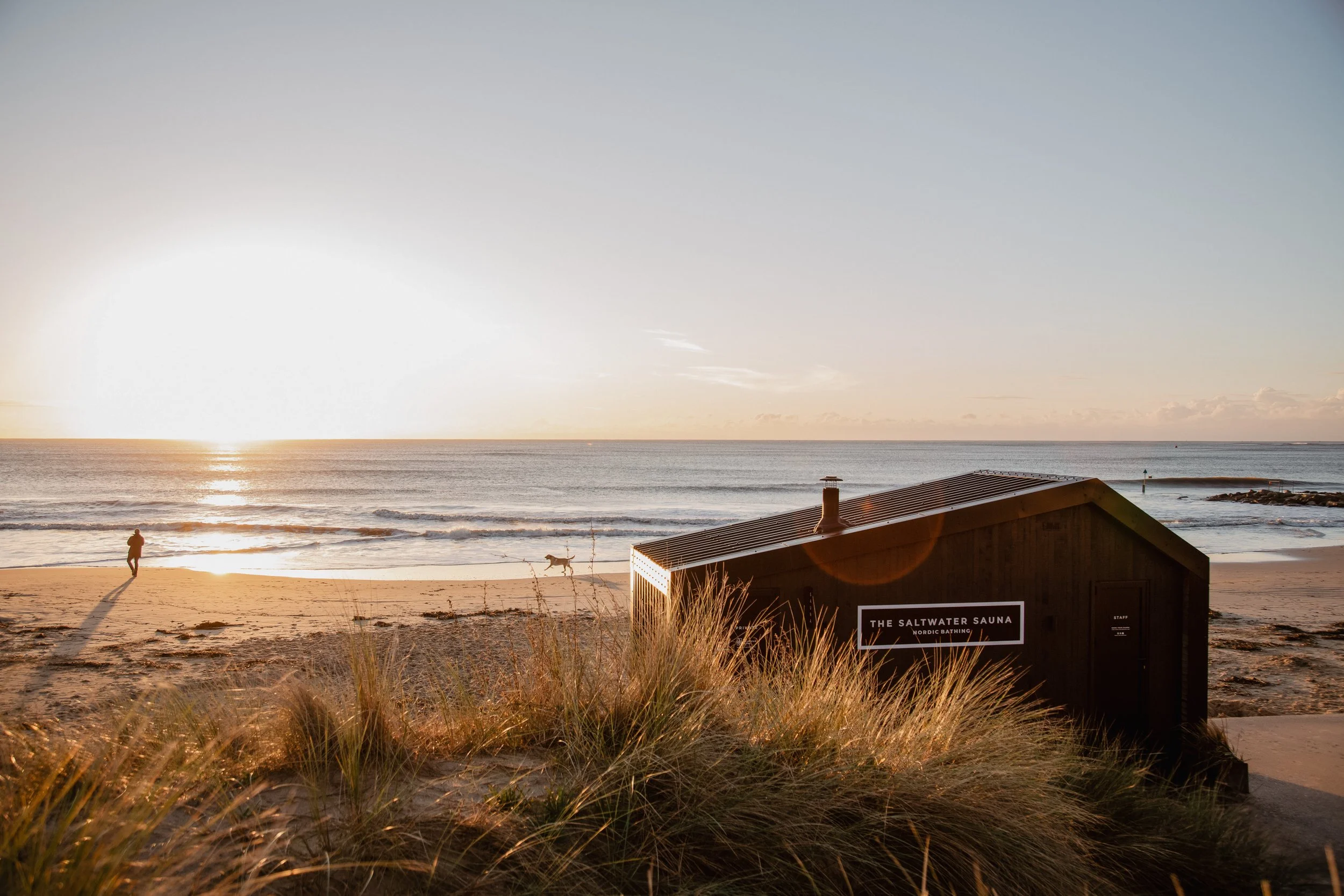
The Saltwater Sauna
Offering the ultimate retreat from the stresses of modern life, The Saltwater Sauna situated on the picturesque Sandbanks beach in Dorset is the extraordinary wellness project of Finnish-born artist and surfer Arlene Lukkarinen, and surfer and cold water immersion enthusiast Sam Glyn-Jones. We caught up with Arlene and Sam to talk about their journey with The Saltwater Sauna, and to find out more about the exciting new wave of sauna culture hitting the UK.
Arlene and Sam with the Saltwater Sauna on Sandbanks beach
The vision for The Saltwater Sauna was originally born out of Sam Glyn Jones’ community surf and wellness project Resurface, which combines surfing, yoga, social connection and cold water therapy in a peer-support program aimed at improving the wellbeing of the local community. It was Resurface’s ‘Rise and Conquer’ events, entailing a facilitated cold water therapy experience in the sea at dawn, combined with a bonfire, music and hot drinks, that sparked the desire for a sauna.
“Amazed by their popularity, we ran the cold water morning dips more and more until I got to the point where I was just crying out for a sauna! I think that those adventurous types who enjoy surfing, yoga and cold water immersion also tend to get really into saunas… These experiences are all about getting back to yourself and getting back to nature” - Sam Glyn-Jones
Sam has experienced what he describes as a ‘very British’ journey into cold water immersion and sauna appreciation.
“I used to run down to the beach and get in the sea with my friends, then make a small fire on the beach to warm our toes up afterwards. We didn’t know about the benefits of cold water immersion at the time, we just felt amazing for it, and that feeling is addictive.
I think the Brits love the excitement and novelty of cold water swimming and sauna bathing, and enjoy the camaraderie that comes with introducing new people to the experience.” - Sam Glyn-Jones
Meanwhile, for Arlene, who grew up in Finland, sauna bathing is deeply ingrained, and cold water immersion forms a part of the traditional sauna bathing cycle.
“People often ask if I am a sauna enthusiast, but I had never really considered myself one because it’s just so much a part of the Finnish culture. I guess I have lived the benefits of sauna bathing and felt them in my body my whole life without really thinking about what they are. For me, getting in the cold sea always needs to be accompanied by a hot sauna before and after.
When I was a child we would go swimming in the sea and there was always a sauna to get into before and afterwards. In the UK, people tend to associate saunas with leisure centres and gyms in enclosed spaces, but in Finland, more often than not saunas are in nature, so you’re fully immersed in the elements.” - Arlene Lukkarinen
Resurface participants enjoy an early morning dip in the sea at Sandbanks beach
Sauna bathers return to The Saltwater Sauna after a swim in the sea
Passionate about providing people with a superior sauna experience, Arlene and Sam got in touch with Heartwood Saunas after realising that an authentic wood-fired sauna would be the pièce de résistance to complete the experience of cold water immersion.
“Quality is really important to both of us, and Heartwood Saunas really stood out as being top quality. We loved their designs and it was clear they had excellent knowledge of sauna building and what makes a great sauna.” - Arlene Lukkarinen and Sam Glyn-Jones.
The couple were keen to to run a sauna at a minimal cost for Resurface participants as part of a therapeutic program, but they were also excited to bring together people in the wider local community and introduce them to the mood-boosting Nordic culture of contrast therapy; cold water immersion paired with traditional sauna bathing. It was also an ambition to make the sauna a profitable business so that Arlene could leave her part-time marketing job and focus on her art, as well as her passion for sauna.
The vision for The Saltwater Sauna was thus realised, and a hugely successful crowd-funder campaign launched in 2020 to help purchase a Heartwood Sauna for Sandbanks beach, which, thanks to Arlene’s hard work, exceeded its target in just over a month.
“Sea swimming at Sandbanks had increased a lot since the pandemic as people reached out to reconnect with themselves and nature. The interest in The Saltwater Sauna from the local community just blew our minds!” - Arlene Lukkarinen
Once they realised it was possible, Arlene and Sam set about working with Heartwood Saunas’ founder Olly Davey to design the ultimate mobile sauna for Sandbanks beach. At one point, the couple made their whole living room a bespoke sauna!
“We had great fun marking it out with furniture and pillows so we could really visualise what the space would feel like!”- Sam Glyn-Jones.
As Arlene explains:
“We had a list of features that we felt we wanted the sauna to have, for example, a changing area and a little office for me to use to stay sheltered from the weather; and we went back and forth with Olly on the phone and through email designing it together for a couple of months. Olly sent us really helpful 3D illustrations and blueprints so we could clearly imagine the space. When after discussions Olly sent us some images of what the sauna could look like from the outside, we were completely blown away by the design, we just thought, this is it!
Olly then stayed in touch to confirm design details as it was built. We always ensured the design included everything that we needed, and made use of Olly’s expertise and knowledge to make sure it all worked.” - Arlene Lukkarinen
Sam and Arlene inside the Saltwater Sauna
Sam and Arlene outside their mobile sauna
The sauna arrived on an exceptionally hot and busy summer’s day and Arlene and Sam fired it up that very evening to enjoy their first sauna on the beach looking out at the ocean. From the get-go, there was a lot of interest from local people and for the first few months, Arlene and Sam found it always took two people to run the sauna: one to run the sauna, one to answer the constant stream of excited questions from intrigued passers-by! The Saltwater Sauna was an instant success; as well as its use as part of the Resurface program, communal and private bookings took off right away and it seems its popularity is only growing.
“I think sauna culture is growing massively in the UK; we get a lot of emails from people wanting to invest, or to set up their own sauna and seeking advice. The increasing popularity of cold water swimming in the UK is definitely helping create more and more demand for sauna bathing.
In Finland, saunas are really quiet, peaceful experiences, but in the UK it’s quite variable. The atmosphere can be more lively because saunas are still quite novel here. Sometimes people love to share and talk and there can be a lot of laughter! It’s really wonderful to see how saunas bring people together here as well as providing relaxation, escapism and health benefits.” - Arlene Lukkarinen and Sam Glyn-Jones.
As The Saltwater Sauna is such a success, Arlene and Sam are now looking to expand and exploring options for another Heartwood sauna at some stage. But for both, establishing a work/life balance that prioritises their own wellbeing is essential, and a key part of The Saltwater Sauna’s philosophy.
“It’s definitely been overwhelming at times so it’s an aspiration to find that slowness that we crave and create a better work/life balance. It’s important that when we do expand, we can do it while taking care of our own mental health” - Arlene Lukkarinen.
“It’s important for us to live a lifestyle that truly means we are relaxed and content, enjoying everything that we do and getting to spend quality time with people.”-Sam Glyn-Jones.
You can find out more about The Saltwater Sauna experience on their website, and book a session to experience the bliss of a seaside Heartwood sauna for yourself.